
 It’s the ultimate dilemma that keeps prospective homebuyers and investors awake at night: “If I don’t buy right now, will I be priced out forever?” As we officially cross into the second half of 2026, the real estate market is sending mixed signals. The fear of missing out (FOMO) is a powerful psychological trigger, especially when you see headlines about skyrocketing property values or changing mortgage rates. But making a massive financial decision based on panic is rarely a good idea.
If you are debating whether to jump into the market or wait on the sidelines, you need to look beyond the daily news cycle. Here is a comprehensive analysis of the top real estate trends you must watch in H2 2026 to make an informed, regret-free decision.
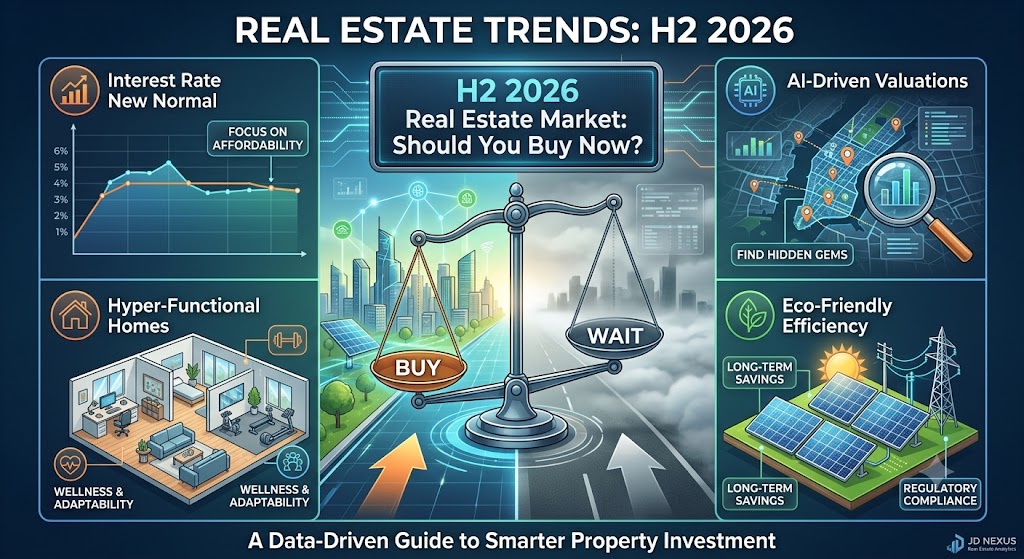
1. The New Normal of Interest Rates
For the past few years, buyers have been holding their breath, waiting for interest rates to drop back to historic lows. The reality in 2026? We have entered a “new normal.”
Central banks have largely stabilized their rates to curb inflation without triggering a severe recession. While we might see minor fluctuations in H2 2026, waiting for a dramatic, sudden drop in mortgage rates might be a losing game.
-
The Takeaway: Instead of trying to time the absolute bottom of the interest rate market, focus on affordability based on current rates. If the math works for your monthly budget now, it might be safer to buy and potentially refinance later than to wait and watch housing prices climb.
2. AI-Driven Property Valuations and “Hidden Gem” Neighborhoods
The integration of Artificial Intelligence in real estate (PropTech) is completely changing how investors find value. AI algorithms are no longer just estimating current home prices; they are predicting future appreciation with startling accuracy.
These tools analyze hyper-local data—from new infrastructure plans and shifting demographic migrations to even the opening of trendy coffee shops—to identify neighborhoods before they boom.
-
The Takeaway: The days of relying solely on traditional “prime locations” are fading. In H2 2026, the smartest investments will be in adjacent, emerging neighborhoods identified by predictive AI analytics. You don’t need a massive budget if you know exactly where the growth is heading next.
3. The “Hyper-Functional” Home Premium
The debate over remote vs. office work has finally settled into a permanent hybrid model for millions of professionals. Because of this, the criteria for a “perfect home” have fundamentally shifted.
Buyers in 2026 are not just looking for square footage; they are looking for hyper-functionality. Homes with dedicated, soundproofed office spaces, private outdoor sanctuaries, and wellness-focused amenities (like built-in air purification or home gym spaces) are selling at a significant premium.
-
The Takeaway: If you are buying an investment property to rent out or flip, prioritizing these functional layouts will guarantee higher demand. If you are buying for yourself, recognize that homes lacking these modern necessities might sit on the market longer, giving you better negotiation leverage.
4. Eco-Friendly is No Longer an “Option”
With rising global energy costs and stricter environmental regulations rolling out in 2026, sustainable housing has moved from a niche luxury to an economic necessity.
Properties equipped with high-efficiency solar panels, smart grid integrations, EV charging stations, and superior thermal insulation are seeing massive demand. Conversely, older homes that require extensive energy retrofitting are facing price reductions.
-
The Takeaway: When calculating the cost of a home in H2 2026, you must factor in long-term utility costs. A slightly more expensive “green” home could actually save you thousands in the long run compared to a cheaper, energy-inefficient property.
The Final Verdict: Should You Buy Now?
So, will you regret not buying now? The answer is no—if you are waiting for the right financial alignment. You will regret buying a house you cannot afford out of sheer FOMO. However, if your finances are stable, you plan to hold the property for at least 5 to 7 years, and you have found a home that aligns with the trends mentioned above, H2 2026 presents a solid window of opportunity. The market has moved past the chaotic bidding wars of the early 2020s into a phase of calculated, strategic growth. Take a deep breath, run the numbers, and let the data—not the fear—guide your investment.
Leave a Reply