
What AI budgeting tools are and why they matter
AI-powered budgeting tools are software applications that analyze your income and spending data to help you plan, track, and optimize your finances. They use machine learning to categorize transactions, detect spending patterns, forecast cash flow, and suggest actionable steps to reach savings goals. For many users, the value comes from automation—reducing manual data entry—paired with personalized insights that adapt as your finances change.
These tools range from simple expense trackers with smart categorization to sophisticated platforms that integrate bank feeds, investments, debt repayment, and goal planning. The goal is not just to see where money goes, but to understand how different decisions affect long-term outcomes and to act on those insights with less friction.
Before diving in, consider your needs: Are you looking to curb discretionary spending, pay off debt, or optimize savings for a specific goal like an emergency fund or travel? The best AI budgeting tool aligns with your priorities and fits into your existing financial routines.
How AI budgeting tools work under the hood
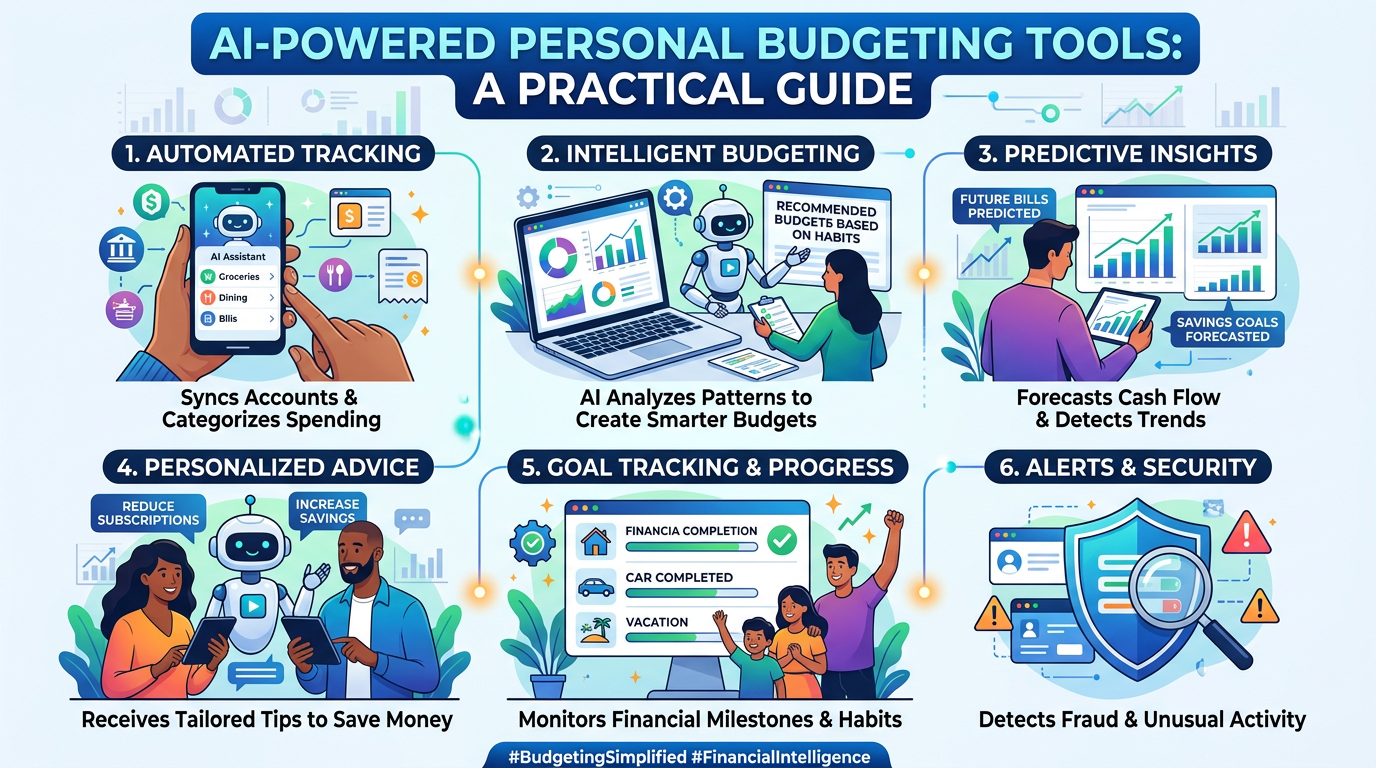
Most AI budgeting tools connect to your financial accounts, import transactions, and automatically tag them into categories. The AI component learns from your past behavior to improve accuracy over time. Common features include:
- Automatic categorization: Transactions are labeled (groceries, dining, utilities) to reveal spending patterns without manual data entry.
- Forecasting: The tool projects future cash flow based on recurring income and historical spending, helping you anticipate potential shortfalls or surplus.
- Goal setting: You define targets (e.g., save $300 a month or pay off a specific debt), and the tool suggests monthly contributions or budget adjustments.
- Alerts and nudges: Timely reminders about bills, price increases, or when you’re veering off track with a goal.
- Scenario analysis: You can simulate changes (salary change, new debt, or a subscription cancellation) to see impact on balance and goals.
Quality AI budgeting tools also emphasize data privacy, provide transparent calculations, and allow you to adjust assumptions. If an app relies heavily on speculative forecasts without clear reasoning, it’s a signal to test reliability or seek alternatives.
Choosing the right tool for your situation
Selecting a budgeting tool is about fit, not just feature count. Use this framework to narrow your choices:
- Define your primary goal: Is it debt repayment, building an emergency fund, or optimizing everyday spending?
- Assess data connections: Do you need to connect bank accounts, credit cards, investment accounts, or all of the above? Ensure the provider supports the institutions you use.
- Evaluate AI capabilities: Look for automatic categorization accuracy, meaningful forecasting, and practical recommendations. Test with a sample of your transactions if possible.
- Check cost structure: Understand pricing tiers, trial options, and whether the features you need are included or require an upgrade.
- Privacy and security: Review data handling policies, encryption, two-factor authentication, and breach history or audits if available.
- Usability and automation: Consider how much time you want to invest in setup and whether automation aligns with your routine.
Common tool archetypes include personal finance apps focused on budgeting, all-in-one financial planners, and debt repayment calculators with AI-driven suggestions. For many users, the sweet spot is a budgeting-focused app with robust automation and clear, actionable guidance rather than a feature-packed but opaque platform.

Practical implementation: a step-by-step starter plan
Follow these steps to start using an AI budgeting tool effectively, without overhauling your entire financial life at once.
Step 1 — Audit your financial inputs
List all income sources and recurring expenses. Gather at least three months of banking transactions if possible. This helps the AI learn your baseline and reduces initial misclassifications.
Step 2 — Set clear, measurable goals
Define one or two primary goals (for example, “save $300 per month” or “pay off $5,000 in credit card debt this year”). Attach sensible timelines and realistic contribution levels to each goal.
Step 3 — Configure categories and priorities
Review automatic categories and adjust any misclassifications. Add custom categories that reflect your actual life (e.g., school tuition, subscription boxes, pet care). Prioritize essential expenses and debt payments first, then discretionary goals.
Step 4 — Link accounts and enable automation wisely
Connect the accounts you regularly use and enable automation for recurring tasks (e.g., automatic transfers to savings or debt payments). For sensitive accounts, consider a staggered setup or read-only access if the tool supports it.
Step 5 — Monitor, adjust, and iterate
Schedule a monthly review to assess progress, adjust targets if needed, and refine categories. Let the AI propose one or two adjustments each month that align with your priorities.
Common use cases and patterns you can expect
AI budgeting tools shine in practical, repeatable scenarios. Here are typical patterns users implement for lasting value.
Pattern A — Friction-free expense tracking
With automatic categorization, most of your daily tracking becomes hands-off. You get a running view of where your money goes without tediously labeling each transaction. This is ideal if you want a clear, real-time picture of spending.
Pattern B — Structured debt payoff
For users with multiple debts, the tool can recommend payoff strategies, like prioritizing high-interest debt or using avalanche/ snowball methods. The AI can suggest monthly payment amounts and timing aligned with your cash flow.
Pattern C — Goal-based saving automation
Set a savings target, and the tool can automate transfers from checking to savings or investments. It can also propose small behavioral nudges—like moving a certain amount from discretionary spending into a savings bucket each week.

Integrations and data privacy: what to inspect
Integration breadth matters, but so does how data is handled. Consider these questions when evaluating an AI budgeting tool.
- Data sources: Which banks, brokerages, cards, and apps can connect? Are there limits on the number of accounts?
- Data storage and security: Where is data stored, and what security measures exist? Are there encryption standards and access controls?
- Data sharing: Does the provider share data with third parties or use aggregated data for analytics? Can you opt out?
- Account safety: Do you need to provide login credentials or use read-only access? What happens if you disconnect an account?
Transparency about AI decisions matters. If the app can’t explain why it recommends a particular adjustment, test it with a hypothetical scenario to see whether conclusions make sense. Prefer tools that provide rationale and visible assumptions behind suggestions.
Budgeting hygiene: avoiding pitfalls
AI tools can be powerful, but missteps can undermine trust and results. Watch for these common pitfalls and how to avoid them.
- Over-reliance on automation: Relying solely on the tool without periodic reviews can lead to drift from your goals. Set a monthly human check-in.
- Data overload: Too many categories can cause confusion. Start with a lean structure and expand only as needed.
- Unclear goals: Without concrete targets, AI output may feel random. Attach explicit targets and timeframes.
- Privacy trade-offs: Linking many accounts increases exposure. Balance convenience with risk by enabling privacy controls and regular reviews of connected accounts.
As with any financial tool, there is no one-size-fits-all solution. The right approach blends automation with intentional financial discipline and periodic reassessment.

How to maximize long-term value from AI budgeting tools
To ensure lasting impact, embed budgeting into your routine and treat the tool as a partner rather than a calculator. Here are practical tips to extract enduring value.
- Make it a habit: Schedule a regular check-in, such as a fixed day each month, to review the budget, adjust goals, and celebrate milestones.
- Use scenarios for planning: Regularly run what-if scenarios to anticipate the effects of changes like a salary bump, a major purchase, or a subscription cancellation.
- Align spending with values: Link your categories to personal priorities (e.g., debt freedom, travel, family needs) to keep motivation high.
- Combine with broader financial planning: Use the tool as a foundation, but integrate with a retirement or investment plan for a fuller financial picture.
FAQs
Q1: Do AI budgeting tools require a lot of setup? A: Some setup is needed to tailor categories and goals, but many tools offer guided setups to speed up the process. If you prefer minimal setup, choose a tool with strong auto-categorization and reasonable defaults.
Q2: Are AI budgeting tools secure? A: Reputable tools use encryption and authentication, and many offer optional read-only access. Always review privacy policies and enable two-factor authentication where available.
Q3: Can AI budgeting tools replace a financial advisor? A: They can supplement planning by providing data-driven insights and automation, but for complex financial situations, professional advice may still be valuable. Do not rely solely on AI for investment or legal decisions.
Q4: How do I know a tool’s recommendations are trustworthy? A: Look for transparent reasoning behind suggestions, test with hypothetical scenarios, and cross-check recommendations against your own knowledge of your finances.
Q5: What happens if I disconnect a linked account? A: Generally, the tool will stop importing data from that account and may reclassify past transactions based on the last known data. Review settings if you disconnect to avoid gaps in budgeting history.
Final Takeaway
AI-powered personal budgeting tools can transform everyday money management by turning data into clear, actionable steps. The key is to choose a tool that aligns with your goals, ensures data privacy, and complements a regular budgeting routine. Start with a focused goal, enable meaningful automation, and commit to monthly reviews that translate insights into tangible financial progress.


Leave a Reply