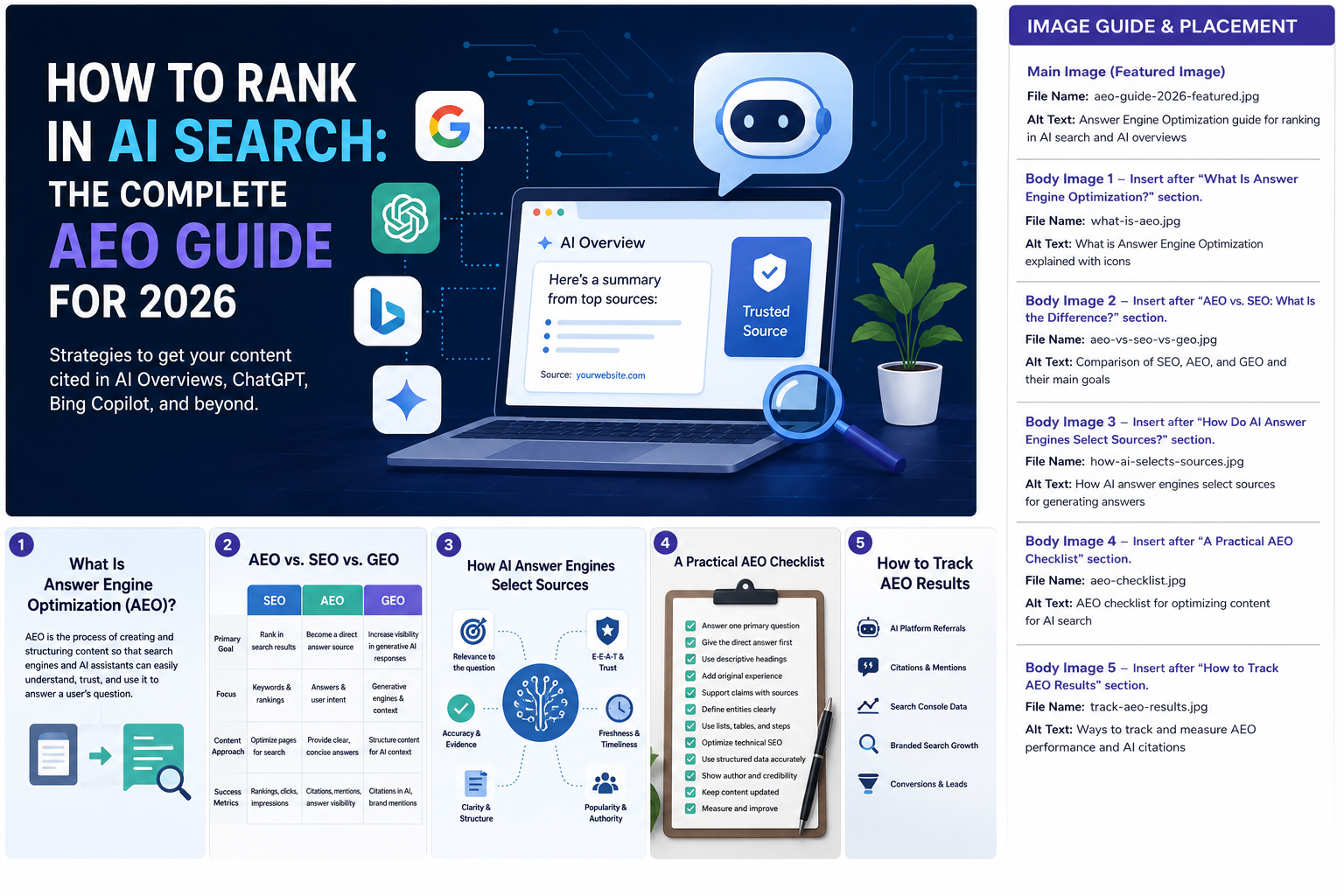

Search is no longer just a list of ten blue links.
Millions of people now ask complete questions and receive synthesized answers from Google AI Overviews, Google AI Mode, Microsoft Copilot, ChatGPT, Perplexity, Gemini, and other AI-powered platforms.
Instead of searching for “best laptop for remote work,” users may now ask:
What is the best lightweight laptop for a remote worker who travels frequently and needs at least 12 hours of battery life?
The search platform can analyze that question, collect information from multiple sources, and generate a direct recommendation.
This shift is creating a new challenge for publishers, bloggers, marketers, and business owners.
Ranking on the first page is still important. But your content must also be easy for an AI system to understand, summarize, trust, and cite.
That is where Answer Engine Optimization, commonly called AEO, comes in.

What Is Answer Engine Optimization?
Answer Engine Optimization is the process of creating and organizing online content so that search engines and AI assistants can easily use it when generating direct answers.
Traditional search engine optimization focuses heavily on helping a webpage rank for keywords.
AEO focuses on helping a specific passage from that webpage become a useful answer.
The two strategies are not competitors.
Good AEO begins with good SEO.
Google’s own guidance states that its generative search experiences remain connected to its core search ranking and quality systems. A page generally needs to be crawlable, indexed, technically accessible, and eligible to appear in regular search results before it can be considered for Google’s AI-powered search features.
AEO simply adds another layer.
Your content should not only rank. It should clearly answer the questions people are asking.
AEO vs. SEO: What Is the Difference?

SEO and AEO share many foundations, including:
- Helpful original content
- Search intent
- Technical accessibility
- Internal linking
- Relevant headings
- Page speed
- Mobile usability
- Author credibility
- Accurate information
- High-quality external references
The biggest difference is the desired outcome.
With traditional SEO, success often means earning a high position in organic search results and attracting a click.
With AEO, success may mean having your information quoted, summarized, cited, or recommended inside an AI-generated answer.
A conventional SEO article might target the keyword:
answer engine optimization
An AEO-focused article would also directly address related conversational questions:
What is answer engine optimization?
Does AEO replace SEO?
How do I optimize a website for AI search?
Can a small blog appear in Google AI Overviews?
How can I measure AI citations?
This question-based structure makes the article more useful to readers and easier for answer systems to interpret.
Why AEO Matters in 2026
AI-powered search is rapidly becoming part of the normal search experience.
Google has continued expanding AI Overviews, AI Mode, conversational follow-up searches, and more advanced AI functions within Search. Microsoft has also introduced AI citation reporting in Bing Webmaster Tools, allowing publishers to see when their pages are cited in Microsoft’s AI-generated answers.
This changes how people discover information.
A user may receive enough information from an AI summary that they no longer need to open several websites. At the same time, the sources selected by the AI can receive valuable visibility, trust, and highly qualified traffic.
Early research also suggests that AI summaries can reduce traffic to some informational pages when users obtain a sufficient answer directly from the search results. This means publishers cannot depend entirely on old keyword-ranking strategies.
The goal is no longer simply to publish more pages.
The goal is to become a source worth citing.
How Do AI Answer Engines Select Sources?

Every AI search system works differently, and no publisher can guarantee inclusion.
However, answer engines generally need content that is:
- Relevant to the user’s exact question
- Easy to retrieve and understand
- Specific rather than vague
- Factually supported
- Current when freshness matters
- Written by a recognizable source
- Consistent with other trustworthy information
- Structured into extractable sections
An AI system does not necessarily need your entire article.
It may use one paragraph, definition, comparison table, statistic, list, or step-by-step explanation.
This is why passage-level clarity matters.
Each important section of your article should make sense even when separated from the rest of the page.
1. Start With Real Questions
Strong AEO content begins with questions, not just keywords.
Before writing an article, identify what the reader is genuinely trying to solve.
For example, someone searching for “heat pump” could have several different intentions:
- What is a heat pump?
- How does a heat pump work?
- Is a heat pump cheaper than a furnace?
- Does a heat pump work in freezing weather?
- What size heat pump does my home need?
- How long does heat pump installation take?
Putting every possible intention into one article can make the page unfocused.
Instead, choose one primary question and organize related follow-up questions beneath it.
Useful places to find questions include:
- Google autocomplete
- People Also Ask results
- Search Console queries
- Reddit and community discussions
- Customer support emails
- Product reviews
- Sales conversations
- YouTube comments
- Questions submitted to AI assistants
Pay particular attention to questions that begin with:
- What is
- How does
- Why does
- When should
- Which is better
- How much
- Can I
- Is it safe
- What happens if
These phrases often reveal clear informational intent.
2. Give the Direct Answer First
Do not make readers search through several paragraphs before receiving the answer.
After a question-based heading, provide a direct answer in the first one or two sentences.
For example:
What is AEO?
Answer Engine Optimization is the practice of structuring accurate, helpful content so that search engines and AI assistants can easily use it to answer a user’s question.
That definition is concise, complete, and understandable without additional context.
You can then add examples, explanations, limitations, and practical advice below it.
A useful pattern is:
- Direct answer
- Important context
- Evidence or example
- Exceptions
- Recommended action
This structure serves readers first while also creating a clear passage that an answer engine can interpret.
3. Make Every Heading Descriptive
Vague headings create unnecessary ambiguity.
Avoid headings such as:
- Introduction
- More Information
- Important Things
- Final Thoughts
- What You Need to Know
Use headings that clearly describe the section:
- What Is Answer Engine Optimization?
- Does AEO Replace Traditional SEO?
- How Long Does AEO Take to Work?
- How Can Bloggers Measure AI Search Visibility?
- What Are the Most Common AEO Mistakes?
Descriptive headings help readers scan the article and help machines understand the relationship between a question and its answer.
Use one clear H1 for the page title. Divide the main ideas with H2 headings and use H3 headings for narrower questions within those sections.
4. Write Self-Contained Answer Passages
Imagine that an AI system removes one paragraph from your article and displays it without the surrounding text.
Would the paragraph still make sense?
Compare these two examples.
Weak:
This is why it is usually the better option for most people.
Strong:
A heat pump is often more energy-efficient than an electric resistance furnace because it transfers existing heat instead of generating heat directly.
The second version identifies the subject and explains the reasoning.
Avoid excessive pronouns such as “it,” “this,” “they,” or “that solution” when the reference is unclear.
Repeat the main entity naturally when necessary.
Clarity is more important than avoiding every repeated word.
5. Add First-Hand Experience
AI can generate basic summaries of widely available information. Generic definitions alone may not differentiate your website.
Your strongest advantage is information that comes from real experience.
Add details such as:
- What you personally tested
- How long you used a product
- Problems you encountered
- Screenshots from your workflow
- Original photographs
- Before-and-after results
- A process that failed and how you fixed it
- Specific costs or time requirements
- Observations from customers or clients
- Original data from your business
Google recommends creating people-first content that demonstrates genuine usefulness rather than producing pages primarily to manipulate rankings. It also encourages publishers to make it clear who created the content, how it was produced, and why it exists.
A useful sentence might be:
I tested this workflow on a five-year-old WordPress website with 127 published articles. The pages with short definitions and specific examples were easier to update and generated more long-tail impressions than the pages built around broad keyword summaries.
Do not invent personal experience.
If you did not test something, clearly state that your conclusion is based on research, documentation, or third-party evidence.
6. Support Claims With Reliable Sources
Answer engines need information they can trust.
When making factual claims, link to the original source whenever possible.
Strong sources may include:
- Government agencies
- Academic research
- Official product documentation
- Regulatory filings
- Standards organizations
- Medical institutions
- Original company announcements
- Direct interviews
- Primary datasets
Avoid citing one low-quality article that simply repeats another article.
Trace the claim back to its original source.
This is particularly important for:
- Medical information
- Financial information
- Legal information
- Safety advice
- Product specifications
- Statistics
- Prices
- Government programs
- Software instructions
- Time-sensitive recommendations
Include the publication or update date when freshness affects the answer.
7. Define Important Entities Clearly
AI systems need to understand what your article is about and how the people, companies, products, and concepts relate to one another.
On first mention, use the full name of an important entity.
For example:
Microsoft Bing Webmaster Tools is a free platform that helps website owners monitor how Bing crawls, indexes, and displays their content.
After establishing the full entity, you can use a shorter version such as “Bing Webmaster Tools.”
Also maintain consistent terminology.
Do not switch unpredictably between several names for the same concept unless you explain the relationship.
For example:
Answer Engine Optimization is often abbreviated as AEO. Generative Engine Optimization, or GEO, is a closely related term that focuses more specifically on visibility within generative AI responses.
This gives both readers and machines a clear relationship between the terms.
8. Use Lists, Tables, and Steps When Appropriate
Some information is easier to understand in a structured format.
Use numbered steps for processes.
Use bullet points for characteristics, requirements, or examples.
Use tables for direct comparisons.
For example:
| Strategy | Primary Goal | Typical Measurement |
|---|---|---|
| SEO | Rank in traditional search | Rankings, clicks, impressions |
| AEO | Become a direct answer source | Citations, mentions, answer visibility |
| Conversion optimization | Turn visitors into customers | Leads, sales, conversion rate |
Do not force every section into a list. A page filled with shallow bullet points can feel fragmented and unhelpful.
Use the format that communicates the answer most clearly.
9. Strengthen Your Technical SEO
AEO cannot rescue a website that search engines cannot properly access.
At a minimum, confirm that:
- Important pages are indexable
- Robots.txt is not blocking essential content
- Pages return the correct status codes
- Canonical tags are accurate
- The website works on mobile devices
- Internal links are crawlable
- Page titles are unique
- Images have descriptive alternative text
- Important text is available in HTML
- The site uses HTTPS
- The sitemap is current
- Broken links are repaired
Google states that pages must meet its basic technical requirements and be eligible for indexing and snippets to appear in its generative search features. Inclusion is never guaranteed, but technical accessibility is the starting point.
10. Use Structured Data Accurately
Structured data helps search engines understand certain types of page information.
Depending on the content, relevant markup may include:
- Article
- BlogPosting
- Product
- Recipe
- Organization
- Person
- BreadcrumbList
- LocalBusiness
- VideoObject
Only use markup that accurately represents visible page content.
Do not label a normal blog post as a product review, recipe, event, or medical page when it does not qualify.
Structured data is not a guaranteed ranking boost and does not force an AI system to cite a page. It is simply one way to communicate page meaning more clearly.
Google has also stated that special AI files or new AI-specific markup are not required for visibility in its generative search experiences. In particular, Google says publishers do not need an llms.txt file to appear in Google Search or its AI features.
What About FAQ Schema?
FAQ sections can still improve the organization and usefulness of an article, but publishers should not create them solely to chase a visual search feature.
Google’s documentation has significantly restricted and subsequently changed FAQ rich-result support. Therefore, write FAQs because they answer real follow-up questions, not because you expect guaranteed dropdowns in search results.
The visible answers on the page matter more than the markup alone.
11. Build a Clear Author and Website Identity
Trust is difficult to establish when readers cannot determine who created the content.
Every serious informational website should have:
- An About page
- A Contact page
- An author name
- An author biography
- A privacy policy
- A clear editorial purpose
- Corrections when errors are discovered
- Disclosure of affiliate relationships
- Sources for important factual claims
For sensitive topics, the author’s relevant qualifications should be easy to verify.
A small blog does not need to pretend to be a large media company.
A transparent individual publisher with genuine expertise and original experience can be more trustworthy than an anonymous content website publishing hundreds of generic articles.
12. Create Topic Clusters Instead of Isolated Posts
One article rarely establishes deep authority.
Build a connected group of pages around a specific subject.
For an AEO website, the cluster might include:
- What Is Answer Engine Optimization?
- AEO vs. SEO vs. GEO
- How to Optimize for Google AI Overviews
- How to Track AI Citations
- How to Write AI-Friendly FAQs
- AEO Checklist for Small Businesses
- Common AEO Mistakes
- Best AEO Tools
- AEO Case Study
Link these pages together naturally.
Each page should answer a distinct question rather than repeating the same introduction with slightly different keywords.
A strong topic cluster helps users explore the subject and demonstrates that the website covers it with depth.
13. Keep Time-Sensitive Content Updated
An article labeled “2026 Guide” should contain information that is genuinely current in 2026.
Review and update:
- Product prices
- Software screenshots
- Search platform features
- Statistics
- Laws and regulations
- Medical guidance
- Official recommendations
- Broken source links
- Company names
- Available tools
Do not change the publication date without making a meaningful update.
Add a visible “Last updated” date and explain major revisions when appropriate.
Content freshness is especially important for AI search because an old passage may be accurate in isolation but misleading under current conditions.
14. Measure More Than Organic Rankings
AEO performance can be difficult to measure because many AI platforms provide limited publisher data.
Track a combination of indicators:
- Branded search growth
- Referral traffic from AI platforms
- Search Console impressions
- Long-tail question queries
- Conversions from informational pages
- Mentions of your brand or domain
- Pages cited by AI systems
- Assisted conversions
- Returning visitors
- Newsletter subscriptions
Microsoft’s AI Performance reporting in Bing Webmaster Tools is designed to show metrics such as total AI citations, cited pages, and the queries connected to those citations. This is an important step toward making AI search visibility measurable.
You can also manually test important questions across several AI platforms, but treat the results carefully.
AI answers can vary by:
- Date
- Location
- account
- personalization
- wording
- model version
- search context
A single manual result is not proof of permanent visibility.
Common AEO Mistakes to Avoid
Publishing Generic AI-Written Articles
AI-assisted writing is not automatically bad. The problem is publishing unverified, repetitive content that adds no original value.
Edit every article for accuracy, usefulness, clarity, and experience.
Hiding the Answer
Long introductions, personal stories, and promotional language can delay the answer unnecessarily.
Provide the useful answer first, then expand.
Creating Hundreds of Near-Duplicate Pages
Changing a city name, product name, or keyword does not automatically create a valuable new page.
Each page needs a distinct purpose and meaningful information.
Making Unsupported Claims
Do not write “research proves” without identifying the research.
Link to the evidence and explain its limits.
Overusing Exact-Match Keywords
Natural language is essential in conversational search.
Use the main topic consistently, but do not repeat the same phrase in every sentence.
Depending on Schema Alone
Schema can clarify content, but it cannot replace helpful writing, technical accessibility, authority, or evidence.
Treating AEO as a Secret Hack
There is no special code that guarantees inclusion in AI answers.
Google explicitly warns that many supposed AEO or GEO shortcuts are unsupported. Its recommendation remains centered on strong SEO fundamentals and useful content.
A Practical AEO Checklist

Before publishing, ask:
- Does the page answer one clear primary question?
- Is the direct answer near the beginning?
- Do the headings reflect real user questions?
- Can each major section make sense independently?
- Are factual claims supported by reliable sources?
- Is the author clearly identified?
- Does the article include original value?
- Is the publication or update date visible?
- Are important entities defined consistently?
- Are lists and tables used where they improve clarity?
- Is the page internally linked to related content?
- Is the page crawlable and indexable?
- Does the mobile version work properly?
- Is structured data accurate?
- Are affiliate and commercial relationships disclosed?
- Does the article help the reader even if no search engine existed?
If the final answer is yes, the page has a solid foundation for both SEO and AEO.
Frequently Asked Questions
Does AEO replace SEO?
No. AEO does not replace SEO. It expands traditional SEO by making content easier for AI-powered search engines and assistants to understand and use in direct answers. Technical SEO, indexing, authority, relevance, and content quality remain essential.
Can a small blog rank in AI search?
Yes, a small blog can appear in AI-generated answers when it provides a highly relevant, specific, trustworthy answer. However, no publisher can guarantee selection, and highly sensitive topics may favor established authoritative sources.
How long does AEO take to work?
There is no fixed timeline. Results depend on indexing, competition, website authority, content quality, topic demand, and how frequently AI platforms refresh their sources. AEO should be treated as a long-term publishing strategy rather than a quick ranking trick.
Do I need an llms.txt file?
Google currently states that publishers do not need an llms.txt file or other special AI-specific markup to appear in Google Search or its generative AI features. Standard crawlability, indexing, content quality, and established SEO practices remain more important.
Should every article have an FAQ section?
No. Add an FAQ section when readers have meaningful follow-up questions that are not already answered clearly in the main article. Do not add repetitive questions merely to increase the page length.
Is structured data required for AEO?
Structured data is not universally required and does not guarantee an AI citation. Accurate structured data can help search engines understand eligible content types, but the visible page content must remain clear and useful.
What is the best content format for AI search?
There is no single best format. Definitions, concise paragraphs, step-by-step instructions, comparison tables, original research, and question-based sections can all work. The best format is the one that answers the user’s intent accurately and efficiently.
How can I track AEO results?
Monitor AI referral traffic, branded searches, long-tail impressions, conversions, citations, and page-level visibility. Bing Webmaster Tools also offers AI Performance reporting for participating users. Because AI answers can change, combine automated data with periodic manual testing.
Final Thoughts
AEO is not about writing for robots.
It is about making human expertise easier to find, understand, verify, and reuse.
The websites most likely to succeed in AI search will not be the ones publishing the greatest number of generic articles. They will be the ones that provide the clearest answers, strongest evidence, most useful experience, and most trustworthy identity.
Start with one important question.
Answer it directly.
Support it with credible evidence.
Add something original.
Keep it updated.
Then connect it to a larger library of genuinely helpful content.
That is not only a practical AEO strategy.
It is also what good publishing has always required.
Tags
Answer Engine Optimization, AEO, AI Search Optimization, Google AI Overviews, Google AI Mode, Generative Engine Optimization, GEO, SEO Strategy 2026, How to Rank in AI Search, ChatGPT Search Optimization, Bing Copilot SEO, AI Content Strategy, Search Engine Optimization


Leave a Reply